Integrating Apparel21 with Shopify: Considerations for Ecommerce Leaders
Phil Preston 14 min read
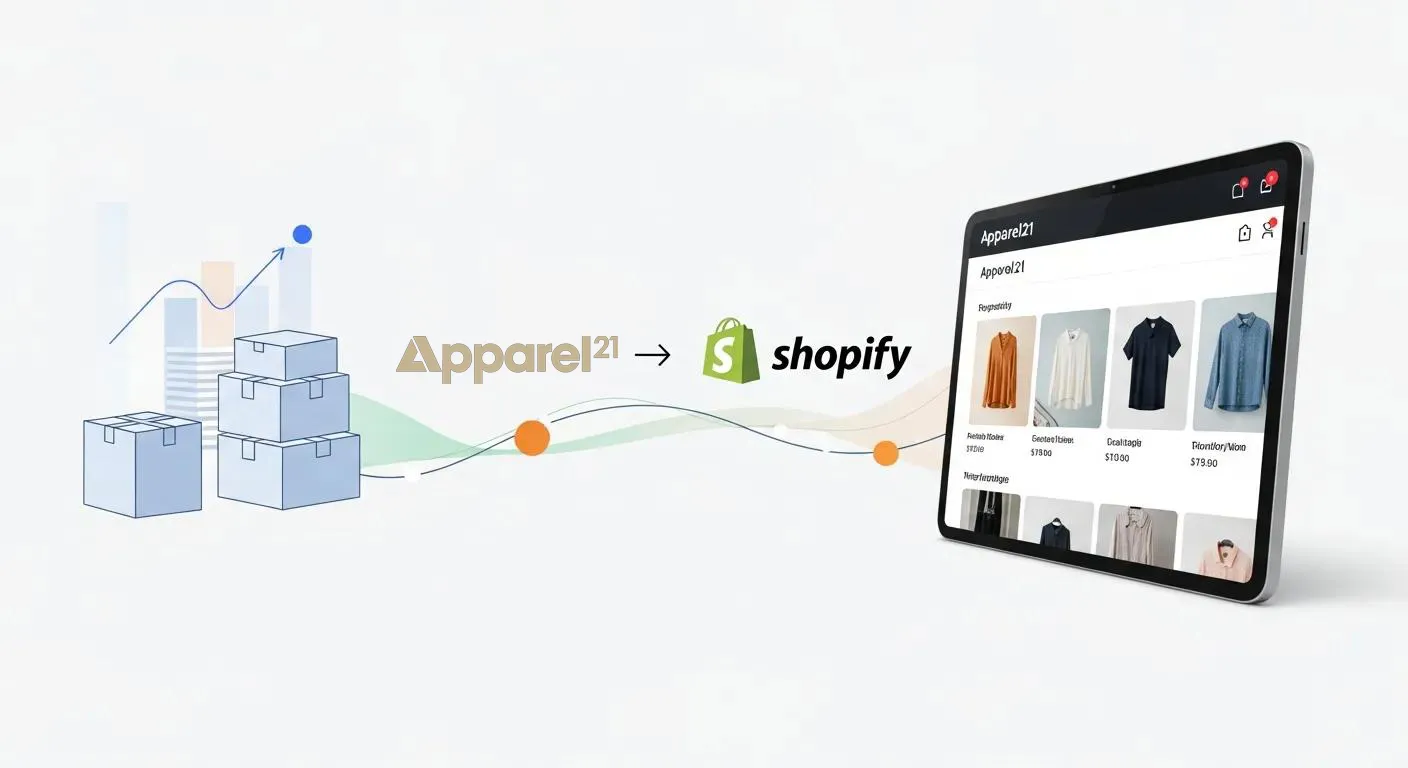
For Australian fashion retailers operating at scale, integration is now critical for operational infrastructure, especially when you’re relying on automation to keep pace with demand swings, store activity, and constant marketing pressure.
If you’re running Apparel21 as your ERP (enterprise resource planning) and Shopify as your ecommerce platform, you’re already sitting on two powerful systems. But without a well-designed AP21 Shopify integration, those systems can quietly work against each other.
Common symptoms of a poorly operating integration include stock that drifts out of sync, orders that fall into manual workarounds and data entry, returns that create reconciliation headaches, and customer service ends up apologising for issues that “shouldn’t happen”.
At the same time, when an Apparel 21 Shopify integration is done properly, it becomes one of the strongest enablers of scale. Inventory accuracy improves. Fulfilment becomes predictable. Ecommerce teams regain confidence to launch promotions, enable click & collect, or fulfil from stores without fear of overselling. This is where an integration stops being “plumbing” and starts behaving like inventory management software your teams can actually trust.
This article is written for CTOs, Heads of Digital, and ecommerce leaders at medium to large retail brands (particularly in Australian fashion and apparel) who need to make a clear-eyed decision about how to integrate Apparel21 with Shopify, what trade-offs are involved, and what “good” really looks like in production.
Why Apparel21–Shopify integration is different in fashion retail
Fashion retail is operationally unforgiving.
Unlike simple ecommerce models, fashion brands operate with:
Large variant matrices (style, colour, size)
Seasonal ranging and rapid catalogue turnover
Multi-location inventory across warehouses and stores
High return and exchange rates
Promotional cadence that can materially change demand overnight and put serious strain on both operations and marketing
Store trade is driven by point of sale activity that must stay aligned with online availability
Apparel21 was created with a focus on dealing with this complexity. It is built to manage fashion-specific realities: ranges, seasons, allocations, store replenishment, and operational reporting.
Shopify, meanwhile, excels in conversion, customer experience, and channel expansion, and serves as the ecommerce platform where campaigns and merchandising go live quickly.
The problem is not capability on either side but more related to coordination. Without a robust ecommerce integration, Shopify becomes a fast-moving storefront that doesn’t fully understand operational constraints, while Apparel21 becomes a back-office system that reacts too late to what’s happening online.
That gap is where most integration failures live.
The strategic question leaders should ask first: Where does truth live?
Before discussing tools, APIs, or middleware, there is a more important question that must be answered clearly:
Which system is the source of truth for which data?
In nearly every successful Apparel21 Shopify integration, the answer looks roughly like this:
Apparel21 is the system of record for:
Products and SKUs
Inventory and availability (including the rules behind what your inventory management software should publish)
Fulfilment status
Operational reporting
Store trade and point of sale context (where relevant)
Shopify is the system of record for:
Customer experience
Checkout and payment gateway handling
Frontend catalogue presentation
Customer-facing order communication
When this boundary is not explicitly defined, integrations can become brittle, resulting in bi-directional updates that overwrite each other, or worse, silent mismatches that only surface when customers complain.
This is not a technical preference. It is an organisational decision that determines how confidently your teams can operate.
Understanding integration approaches: not all roads scale
There are three broad approaches brands take to an AP21 Shopify integration. Each can work, but only in the right context.
1. Direct, point-to-point integrations
This is the simplest model: Shopify talks directly to Apparel21 through APIs or database connectors.
On paper, this looks attractive. Fewer components. Faster to build. Lower initial cost.
In practice, point-to-point integrations tend to struggle as complexity grows. Every new workflow (click & collect, store fulfilment, exchanges, transfers) adds more conditional logic. Error handling becomes bespoke, and monitoring is often minimal.
What started as “just syncing orders and stock” turns into a fragile web of scripts that only one or two people truly understand.
For low-volume or early-stage brands, this may be acceptable. For medium to large-sized retailers, it rarely survives in the long term without major rework.
2. Connector or middleware-driven integrations
Apparel21 promotes its own connectivity layer, and there are also third-party middleware platforms designed to link ERPs and ecommerce platforms.
These approaches can accelerate initial delivery and reduce the need for custom code. They are often well-suited to standard flows such as:
Product creation
Inventory updates
Order ingestion
The trade-off is flexibility: When your business deviates from the “happy path”, and fashion retail almost always does, you may find that edge cases leak back into manual processes. Returns don’t quite reconcile. Multi-location fulfilment requires workarounds. Promotions behave differently online than expected.
Middleware can be a strong foundation, but only if you are clear about where configuration ends and custom logic begins.
3. Bespoke integration services (the enterprise pattern)
For retailers with tight operational SLAs, bespoke integration layers are often the most sustainable option.
This does not mean reinventing the wheel. It means designing an integration as a product in its own right:
Explicit data models
Event-driven processing where timeliness matters
Batch processing where scale matters
Monitoring, alerting, and reconciliation as first-class concerns
This approach costs more upfront, but it dramatically reduces long-term operational risk. It also gives leadership clearer visibility into what the system is doing and why.
For organisations that treat ecommerce as a core revenue engine, this pattern consistently proves its value.

Inventory: the single biggest risk and opportunity
If there is one area where Apparel21 Shopify integrations succeed or fail, it is inventory.
Inventory is deceptively complex:
On-hand vs committed vs incoming stock
Location-specific availability
Safety stock and buffers
Allocation rules for stores vs online
Transfers and replenishment timing
Shopify supports multi-location inventory, but it does not inherently understand the operational intent behind those numbers as Apparel21 does. A strong integration deliberately translates Apparel21’s inventory semantics into Shopify’s model with specific intent and behaves like inventory management software rather than a basic “sync”.
Overselling is rarely a technical bug
In post-mortems, Fontis often finds that overselling is not caused by a broken API call. It is caused by unclear inventory rules and lack of planning.
Common examples include:
Publishing on-hand stock instead of available-to-promise
Failing to subtract committed store allocations
Treating transfers as available stock too early
Not accounting for returns in transit
When teams treat inventory as “just a number to sync”, Shopify becomes overly optimistic. Customers place orders that operations cannot fulfil, which quickly erodes trust.
A well-designed ecommerce integration makes these rules explicit and testable, and keeps your inventory management software reality aligned across channels.
Orders: lifecycle matters more than ingestion
While getting orders from Shopify into Apparel21 is easy, getting them through their full lifecycle correctly is not so simple.
Orders move through many states:
Created
Paid
Allocated
Picked
Packed
Shipped
Returned
Refunded
Exchanged
Cancelled
Each of these transitions has operational and financial consequences. In weaker integrations, orders are treated as static objects, while in stronger integrations, orders are treated as state machines: this is an important distinction.
Partial fulfilments and real-world retail
Fashion retailers regularly deal with partial fulfilments, such as one item shipping from a warehouse while another ships from a store and/or another is cancelled due to damage.
Both Shopify and Apparel21 support this, but the integration must coordinate it. Where integrations fail, teams often fall back to manual reconciliation: updating statuses by hand, issuing refunds outside the system, or adjusting stock retrospectively.
However, at scale, this is unsustainable.
Returns, exchanges, and refunds: where integrations earn their keep
Returns are where theoretical architectures meet reality. Australian fashion retailers often face high returns and exchange rates driven by fit, style, and customer expectations. Returns are not edge cases; rather, they are core workflows.
A strong Apparel 21 Shopify integration ensures that:
Returns initiated online are reflected operationally
Exchanges adjust inventory correctly
Refunds reconcile cleanly with financial reporting
Stock re-enters availability only when appropriate
This domain is often underestimated during planning, only to discover later that finance and customer service are spending hours each week reconciling mismatches. If your integration handles returns cleanly, it is doing critical value delivery behind the scenes.
Performance, reliability, and why “real-time” is not a goal
“Real-time” is often used as shorthand for “fast enough to be safe”.
Shopify imposes API rate limits while Apparel21 has its own performance characteristics. Sales events can create bursts of activity that no steady-state system sees. A mature integration design acknowledges this and plans accordingly.
That typically means:
Event-driven updates for critical flows (orders, fulfilment)
Batch processing for heavy data (catalogue, historical updates)
Queues, retries, and idempotency
Clear back-pressure handling during peak load
The goal is not zero delay, but rather predictable behaviour under stress. When pondering “What happens during Black Friday?” the answers should be grounded in architecture rather than hope.
Observability: if you can’t see it, you can’t trust it
One of the most overlooked aspects of AP21 Shopify integration projects is observability. If an order fails to sync at 2am, is it reported? If inventory stops updating for one location, how long until team are aware and can react? If refunds don’t reconcile for a day, where is that surfaced?
In strong integrations, observability is built in: structured logs are tied to SKUs and order IDs, dashboards show sync health and lag, alerts when thresholds are breached and reconciliation jobs that flag discrepancies.
These are not “nice to have” features of an integration. It is what allows ecommerce leaders to sleep at night.
Security, governance, and change management
Integrations are not one-off systems. As Shopify and Apparel21 evolve, your business also evolves and its needs change. Without governance, integrations quietly degrade.
Key considerations for any long-term critical integration should include:
Scoped API access and credential rotation
Versioned API usage and upgrade planning
Staging environments for testing changes
Clear ownership of integration health
The most damaging failures are rarely dramatic outages. Often, they are subtle drifts caused by untested changes. Good governance should be in place to specifically prevent silent breakage.
Real-world signals from the Australian market
Publicly documented Australian retailers using Shopify alongside Apparel21 consistently describe the integration layer, not the storefront, as the enabler of scale.
Where details are shared, common themes emerge:
Middleware or bespoke layers sitting between systems
Emphasis on inventory accuracy and operational control
Focus on reducing manual intervention as brands scale
What is not publicly visible, but is consistently observed, is the amount of engineering effort that goes into making these integrations reliable, not just functional.
Partnering with an expert integration team
An experienced integration partner goes beyond writing code to actively reduce risk across the entire commerce operation.
An experienced integration partner reduces risk before it materialises. Instead of reacting to issues after go-live, they pressure-test assumptions during discovery. Where does inventory truth live? How are exchanges reflected financially? What happens during a flash sale when order volume spikes? These are commercial questions rather than technical ones. Addressing them early protects margin, brand reputation, and internal credibility.
Senior integration teams design for resilience, not just functionality. They assume APIs will throttle, networks will fail, and edge cases will appear. Retry logic, reconciliation processes, and structured monitoring are built in from day one. The outcome is continuity: orders do not disappear, stock does not silently drift, and customer service is not forced into manual workarounds and data entry that erode trust and inflate operational cost.
There is also a strategic advantage in translating retail workflows into robust technical models. Fashion businesses operate with seasonal ranges, multi-location inventory, partial fulfilments, and high return volumes. An integration that truly reflects these realities reduces friction across ecommerce, warehouse, finance teams, and point of sale operations. It improves fulfilment speed, tightens stock accuracy, and reduces reconciliation overhead. That efficiency compounds over time.
Executive teams should also care about visibility. A well-architected integration does not operate as a black box. It provides reporting, alerts, and reconciliation checkpoints that surface issues before they escalate. This gives leaders confidence to scale, whether that means launching aggressive promotional campaigns, enabling store fulfilment, or expanding into new markets. Growth becomes a controlled decision, and a safer lever for marketing and merchandising.
Finally, experienced partners are honest about trade-offs. Not everything needs to be real-time. Not every workflow should be automated, and not every integration pattern is sustainable at scale. Clear articulation of these decisions enables leadership to intentionally balance performance, cost, and complexity, rather than discovering hidden compromises later.
For medium to large retailers, integration is not a project. It is infrastructure. The difference between a connector and a considered architecture becomes visible over time in margin protection, operational stability, and leadership confidence.
At Fontis, this backend-first, vendor-agnostic approach is deliberate. It reflects the reality that ecommerce performance is determined long before the customer sees the frontend.
Final thoughts: integration as a competitive advantage
For medium to large fashion retailers, an Apparel21 Shopify integration is not a technical checkbox. It is the backbone that determines whether ecommerce can scale confidently, whether operations can keep up with demand, and whether customers trust the brand.
Done poorly, integration becomes a constant source of friction.
Done well, it disappears into the background, quietly enabling growth, and gives your teams more headroom to invest in marketing, merchandising, and omnichannel initiatives like point of sale-aware inventory.
If you’re evaluating or re-evaluating your Apparel 21 Shopify strategy, the most important step is not choosing tools. It is choosing to treat integration as critical infrastructure, deserving of the same rigour as any other core system - including how it handles checkout and payment gateway flows.
Frequently Asked Questions
1. Do we really need a dedicated integration between Apparel21 and Shopify?
If you are operating at medium to large scale, with multiple stores, significant online volume, and tight fulfilment expectations, the answer is almost always yes.
Manual processes or lightweight connectors tend to introduce delays, reconciliation work, and inconsistent inventory. A well-designed ecommerce integration replaces manual workarounds and reduces operational risk, particularly when stores, warehouses, and online orders all compete for the same stock pool.
2. Should Apparel21 or Shopify be the source of truth?
In most Australian fashion retail environments:
Apparel21 (your enterprise resource planning system) is the source of truth for:
Products and SKUs
Inventory
Fulfilment status
Financial reporting
Shopify (your ecommerce platform) is the source of truth for:
Customer experience
Checkout and payment gateway transactions
Frontend merchandising
What matters most is clarity. Integration issues usually arise when leadership has not explicitly defined ownership boundaries between systems.
3. Is real-time inventory sync essential?
Not always. What matters is “fast enough to be safe.”
For high-velocity SKUs, promotions, or store-fulfilled orders, near real-time updates are often necessary to prevent overselling. For slower-moving products, scheduled updates may be sufficient.
The goal is not zero delay. The goal is predictable behaviour under load, especially during campaigns or peak trading periods driven by marketing activity.
4. Can we rely on a pre-built connector instead of a bespoke solution?
Pre-built connectors can work well for standard workflows such as:
Basic product sync
Order ingestion
Inventory updates
However, as operational complexity increases (multi-location fulfilment, exchanges, transfers, click & collect), edge cases tend to appear.
If your retail model includes store fulfilment, complex returns, or tight SLAs, a bespoke or carefully architected integration layer typically provides better long-term resilience and visibility.
5. What are the most common causes of integration failure?
In fashion retail, failures are rarely caused by a single broken API call.
Common causes include:
Unclear inventory rules
Inconsistent SKU mapping
Manual data entry workarounds creeping back in
Poor reconciliation processes
Lack of monitoring and alerting
Most issues are governance or process gaps exposed by technology, not purely technical defects.
6. How does integration affect our stores and point of sale operations?
Integration becomes especially valuable when online and store channels share inventory.
If designed properly, integration ensures:
Store sales update online availability
Online orders can be fulfilled from store inventory
Returns processed at point of sale reflect correctly in inventory and financial systems
Without coordination, stores and ecommerce compete for stock instead of operating as a unified system.
7. What should we look for in an integration partner?
Look for a team that:
Understands fashion retail workflows (ranges, allocations, seasonal cycles)
Designs for resilience, not just functionality
Builds monitoring and reconciliation into the solution
Clearly articulates data ownership boundaries
Is transparent about trade-offs between cost, complexity, and performance
A strong partner treats integration as infrastructure, not just a development task.
8. How long does an Apparel21–Shopify integration take?
Timelines vary based on complexity.
A relatively standard implementation may take several weeks. More complex environments (multi-brand, multi-location, custom fulfilment rules) can take significantly longer.
What matters more than speed is thoroughness. Rushed implementations tend to surface operational issues post-launch which is often the worst possible time.
9. How do we know if our current integration needs improvement?
Warning signs include:
Frequent inventory mismatches
Manual reconciliation between systems
Customer service dealing with preventable fulfilment issues
Finance spending excessive time aligning online orders with ERP reports
Limited visibility into sync failures
If integration health is unclear, that uncertainty itself is a signal. Mature systems provide observability and reporting that enable measurable, trustworthy performance.
10. Is integration a one-time project?
No. As Shopify, Apparel21, and your business evolve, the integration must evolve with them.
New sales channels, fulfilment models, pricing strategies, and compliance requirements all affect how systems interact.
Treat integration as long-term infrastructure. When it is engineered properly, it quietly enables growth, freeing your teams to focus on product, experience, and strategy rather than firefighting operational friction.